Akademia NIS2/KSC2 od sekuraka. 19 października start drugiej edycji!
Konferencja Mega Sekurak Hacking Party w Krakowie – 26-27 października!
Akademia NIS2/KSC2 od sekuraka. 19 października start drugiej edycji!
Konferencja Mega Sekurak Hacking Party w Krakowie – 26-27 października!

Środowiska developerskiego Visual Studio nie trzeba przedstawiać. To bardzo zaawansowane narzędzie od Microsoft, skrywające wiele ficzerów przydatnych programistom, a także pentesterom i badaczom bezpieczeństwa.
W ostatni Patch Tuesday Microsoft wypuścił łatkę na podatność umożliwiającą eskalacja uprawnień (privilege escalation), która otrzymała identyfikator CVE-2024-20656. Autorem znaleziska jest Filip Dragovic z MDsec.
W czym leży problem? VS pozwala na rozszerzenie funkcjonalności przez instalację dodatkowych „pakietów”. Jednym z nich jest komponent umożliwiający pracę z projektami w językach C i C++. Wykorzystuje on usługę VSStandardCollectorService150, która pełni role diagnostyczne podczas debugowania projektu. Usługa ta jest uruchamiana w kontekście NT AUTHORITY\SYSTEM.
PS C:\\Users\\doom> sc.exe qc VSStandardCollectorService150[SC] QueryServiceConfig SUCCESSSERVICE_NAME: VSStandardCollectorService150 TYPE : 10 WIN32_OWN_PROCESS START_TYPE : 3 DEMAND_START ERROR_CONTROL : 0 IGNORE BINARY_PATH_NAME : "C:\\Program Files (x86)\\Microsoft Visual Studio\\Shared\\Common\\DiagnosticsHub.Collection.Service\\StandardCollector.Service.exe" LOAD_ORDER_GROUP : TAG : 0 DISPLAY_NAME : Visual Studio Standard Collector Service 150 DEPENDENCIES : SERVICE_START_NAME : **LocalSystem**PS C:\\Users\\doom>Wykorzystanie podatności wymaga wykonania szeregu działań, które w efekcie umożliwią podniesienie uprawnień użytkownika, które zostały zaprezentowane w dokładnym opisie podatności:
- Create a dummy directory where the VSStandardCollectorService150 will write files.
- Create a junction directory that points to a newly created directory.
- Trigger the VSStandardCollectorService150 service by creating a new diagnostic session.
- Wait for the <GUID>.scratch directory to be created and create new object manager symbolic link Report.<GUID>.diagsession that points to C:\\ProgramData .
- Stop the diagnostic session.
- Wait for the Report.<GUID>.diagsession file to be moved to the parent directory and switch the junction directory to point to \\RPC Control where our symbolic link is waiting.
- Sleep for 5 seconds (not really important but left it there).
- Switch the junction directory to point to a dummy directory.
- Start a new diagnostic session.
- Wait for <GUID>.scratch directory to be created and create a new object manager symbolic link Report.<GUID>.diagsession that points to C:\\ProgramData\\Microsoft
- Stop the diagnostic session.
- Wait for the Report.<GUID>.diagsession file to be moved to parent directory and switch the junction directory to point to \\RPC Control where our symbolic link is waiting.
- After the permissions are changed we delete the C:\\ProgramData\\Microsoft\\VisualStudio\\SetupWMI\\MofCompiler.exe binary.
- Locate and run the Setup WMI provider in repair mode.
- Wait for our new MofCompiler.exe binary to be created by the installer and replace it with cmd.exe
- Enjoy SYSTEM shell 🙂
Jak widać, nadużycie VSStandardCollectorService150 to złożony proces opierający się na resetowaniu DACL (Discretionary Access Control List), odpowiednim wyczuciu czasu oraz żonglowaniu dowiązaniami symbolicznymi.
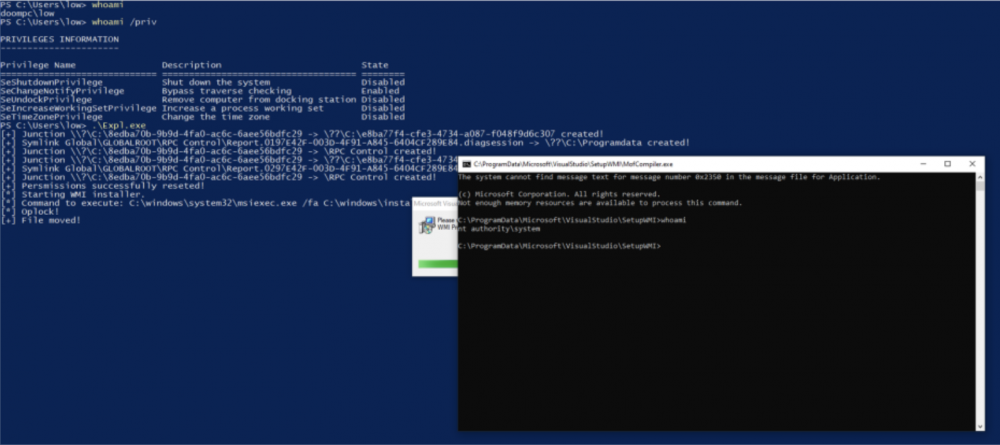
Luka została już naprawiona, a na GitHubie pojawił się PoC, a także na Twitterze/X https://twitter.com/filip_dragovic/status/1744819969882231206
~fc